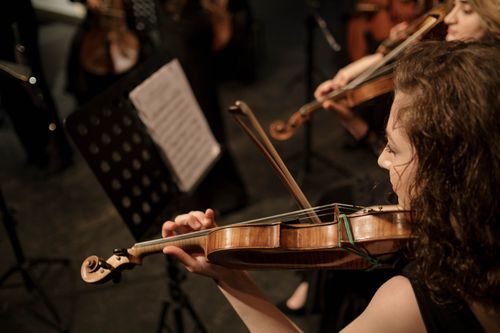
photo credit: Cottonbro Studio / Pexels
Key Takeaways
- Orchestra sheet music preparation involves much more than printing parts, requiring staff to confirm the correct edition, complete instrumentation, readable pages, markings, and other performance details before rehearsal begins.
- Choosing the correct edition helps ensure that the conductor’s score and musicians’ parts contain consistent cuts, corrections, bowings, rehearsal markings, and other instructions needed for an aligned performance.
- Music libraries must carefully review physical and digital materials for missing pages, incorrect parts, unclear printing, difficult page turns, and other issues that could interfere with musicians during rehearsal.
- Licensing and permission requirements are an important part of preparation because orchestras may need authorization to copy, scan, arrange, digitally distribute, rent, or otherwise use particular music materials.
- Effective preparation gives musicians time to review their parts before rehearsal, allowing the conductor and ensemble to focus valuable rehearsal time on musical interpretation instead of resolving avoidable material and administrative problems.
Yun Cao is a Miami-based conductor, arts administrator, and pianist recognized for his musical versatility and collaborative leadership style. He currently serves as music director of the Aurora Philharmonic and managing director of JSGS Publishing, a classical music publishing company in Coral Gables, where he oversees catalogue strategy, editorial guidance, and partnership negotiations. Yun Cao previously served as associate conductor and manager of the Frost Symphony Orchestra and as assistant conductor of the Palm Beach Symphony. He holds a doctorate in orchestral conducting from the University of Miami Frost School of Music and was recently credited as assistant music director on an Emmy-nominated recording of Beethoven’s Ninth Symphony.
His extensive experience preparing orchestras for performance gives him firsthand insight into how ensembles ready sheet music before rehearsal begins.
Before an orchestra rehearses, its staff must turn a confirmed concert program into usable materials for players. The work starts after the staff knows what music the orchestra will perform. The goal is not to place paper on stands, but to prepare parts that match the planned performance.
Prepared sheet music includes several checks. The orchestra needs the correct edition, complete instrumental parts, readable pages, necessary markings, timely distribution, and proper authorization or licensing.
In this setting, an edition means the published version that the orchestra selects for the performance. Different editions may contain different cuts, errata, bowings, rehearsal markings, page layouts, or performance details.
The music director and artistic leadership work with the orchestra librarian or library team to confirm the edition, version, and publication. That choice helps align the conductor’s score with the players’ parts. One version may carry cuts, corrections, or bowings that another version does not contain, so the library check helps prevent score-and-part conflicts before rehearsal.
The library team then obtains the materials the orchestra will use. Some music comes from the orchestra’s collection, while other pieces come from publishers, dealers, rental agencies, arrangers, or other orchestras. Even when the underlying composition is out of copyright, the selected publication may still matter because a modern edition, arrangement, or rental publication may carry its own permissions or use terms.
After the materials arrive, the library team checks the set itself. A complete set includes the correct scores and parts for the instruments assigned to the performance.
The team may review owned music, rented music, physical materials, digital files, replacement pages, and missing items. This check identifies gaps before the materials reach musicians.
Preparation also includes markings that guide the players. A cut tells musicians to skip a marked section. Errata are corrections to printed mistakes.
A bowing instruction tells string players which direction to move the bow, so players in the same section can follow consistent instructions.
The team also checks whether the pages work for live playing. A part may contain the right notes but still create problems if the print is unclear, pages are out of order, or a page turn interrupts a difficult passage.
Page-turn review looks at how a musician will physically use the part while playing.
Permission questions can affect the materials before distribution. Musicians and organizations cannot assume they may copy, scan, arrange, rent, distribute, lend, or store every piece of music digitally.
Licensing means permission to use music materials under rules set by the rights holder, publisher, rental agent, or agreement. The orchestra should resolve copying, digital access, arrangement, and rental-use questions before sending parts to players.
Distribution gives musicians time to prepare their own assignments. A player may review the assigned part, markings, page turns, and preparation requirements before the ensemble gathers.
Musicians may also need time to confirm instrumentation and part-specific needs.
Operational planning keeps the process on schedule. Staff may need to track music purchases, rental terms, delivery dates, physical set preparation, digital access, rehearsal deadlines, return checklists, and replacement costs.
Rental materials can add collection, inspection, packing, shipping, inventory, and return steps after the performance.
On rehearsal day, players should open physical or digital parts that carry the same approved instructions. The conductor can use rehearsal time for musical work instead of checking basic materials, correcting notes, coordinating bowings, or communicating cuts.
That outcome shows how library preparation supports rehearsal rather than sitting outside it as a separate administrative step.
FAQs
What does an orchestra librarian do before rehearsal?
An orchestra librarian or library team prepares the music materials needed for the performance. This can include confirming editions, obtaining scores and parts, checking completeness, reviewing markings and page turns, managing permissions, and distributing materials to musicians.
Why does an orchestra need to select the correct edition?
Different editions of the same composition can contain different cuts, corrections, bowings, rehearsal markings, layouts, and performance instructions. Selecting and distributing a consistent edition helps ensure that the conductor and musicians are working from compatible materials.
What are bowings and errata in orchestral sheet music?
A bowing indicates the direction in which string players should move their bows, helping musicians within a section play with greater consistency. Errata identify corrections to mistakes found in printed music.
Why are page turns important when preparing orchestral parts?
Musicians need to turn pages while continuing to perform, so poorly positioned page turns can interrupt difficult passages or make playing unnecessarily difficult. Reviewing page turns helps ensure that parts are practical and readable during live performance.
Why do orchestras need to consider music licensing before rehearsal?
Copyright and licensing rules may affect whether an orchestra can copy, scan, digitally distribute, arrange, rent, lend, or store particular music materials. Resolving these permissions before distribution helps the organization avoid legal and operational problems.
About Yun Cao
Yun Cao is a Miami-based conductor and arts administrator who serves as music director of the Aurora Philharmonic and managing director of JSGS Publishing. He previously held posts with the Frost Symphony Orchestra and the Palm Beach Symphony, and he holds a doctorate in orchestral conducting from the University of Miami. Cao has conducted at Carnegie Hall, the Kennedy Center, and other major venues across the United States, Asia, and Europe, and was recently credited on an Emmy-nominated recording.