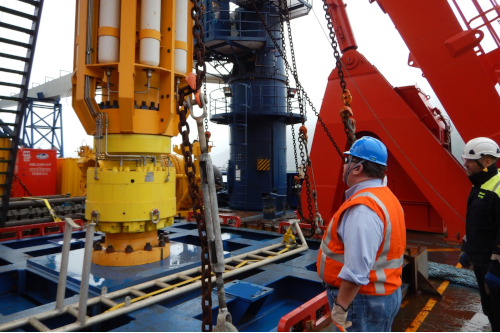
photo credit: CC0
Key Takeaways
- Modern technologies are helping energy companies locate and develop previously inaccessible oil and gas resources more efficiently.
- Advanced seismic imaging provides detailed underground maps that improve exploration accuracy and reduce unnecessary drilling.
- Artificial intelligence and machine learning analyze geological and operational data to optimize drilling decisions and reservoir management.
- Horizontal drilling and Industrial Internet of Things technologies improve resource recovery, operational safety, and equipment performance.
- Balancing technological innovation with environmental responsibility and economic feasibility remains a key challenge for the energy industry.
A geography and environment graduate of Texas Tech University with a minor in geographic information systems, Ian Ferrell Texas aims to build a career in the energy sector. During two internships with Plains All American Pipeline Company – one in Houston and one in Midland, Texas – he developed hands-on experience with GIS mapping, midstream oil and gas operations, pipeline maintenance, and field operations in the Permian Basin. Mr. Ferrell is also interested in how AI mapping, cleaner energy technology, and GIS tools can address pressing questions in energy production and sustainability.
His academic focus on geography and natural systems provides grounding in the evolving intersection of technology and natural resource management that defines modern energy exploration.
The global demand for energy is rising steadily as industries expand, populations grow, and developing economies increase their electricity and fuel demand.
Although renewable energy is becoming increasingly popular and important, oil and gas still play an essential role in powering transportation, manufacturing, and electricity generation. However, many easily accessible energy reserves have already been exploited, forcing companies to search for untapped resources in deeper, more remote, and geologically complex environments.
Technology is helping drilling companies exploit these untapped reserves with high accuracy, low operational risks, and minimal environmental impact. Instead of relying on traditional trial-and-error drilling methods, modern exploration companies are leveraging advanced seismic imaging, artificial intelligence (AI), advanced drilling technologies, and the Industrial Internet of Things (IIoT).
Seismic imaging works by sending sound waves underground and analyzing how those waves bounce back from different rock formations. This allows geologists to create maps of subsurface structures and identify potential oil and gas reservoirs. Importantly, traditional seismic methods provided limited detail, but modern three-dimensional (3D) and four-dimensional (4D) seismic imaging technologies now produce highly detailed representations of underground formations. These advanced technologies help companies understand reservoir depth, size, and composition with great accuracy.
3D seismic imaging simplifies complex geological formations for drillers, generating realistic underground models. This insight helps identify hydrocarbon-rich zones while avoiding dry wells that waste time and resources. 4D seismic technology further improves exploration efficiency by monitoring reservoir changes over time. This allows drilling companies to observe how pressure, temperature, and fluid movement change during production. Such insights improve reservoir management and maximize resource recovery, and 4D imaging has particularly proven resourceful in offshore drilling operations where exploration costs are significantly high, and precision is essential.
AI, on the other hand, is transforming energy exploration. Oil and gas companies are increasingly relying on and generating vast amounts of data, especially geological and operational information. These organizations are leveraging AI systems to process these datasets and identify important patterns that human analysts may overlook. Through predictive analytics and automated interpretation, AI improves exploration accuracy and speed, and reduces uncertainty.
Machine learning, a branch of AI, is enabling and improving reservoir modeling. Machine learning algorithms analyze geological information, drilling records, and production data to predict subsurface conditions and reservoir behavior. This technology helps companies determine suitable drilling locations and production strategies, reducing operational costs and limiting environmental disruption.
Advanced drilling technologies are also helping companies access previously unreachable energy reserves. Horizontal drilling techniques, for instance, allow wells to reach targets located deep underground or beneath difficult terrain. Instead of drilling vertically, companies now drill horizontally across reservoirs, increasing resource recovery and improving efficiency.
The IIoT has also become an important component of modern energy exploitation. IIoT uses connected sensors, real-time monitoring tools, and data analytics platforms to track drilling operations and equipment performance. These systems improve operational efficiency by enabling predictive maintenance, reducing the likelihood of equipment failures, and supporting quick decision-making. Real-time monitoring also improves worker safety and enables drilling companies to optimize resources during exploration.
Despite its importance in exploring untapped reserves, leveraging technology faces three primary challenges. These advanced exploration systems require significant financial investment, and this may lock out small energy firms. Besides, the drilling industry faces increasing environmental scrutiny since fossil fuel exploration contributes to carbon emissions and climate change concerns. Governments, environmental organizations, and international agencies continue to push for clean energy alternatives, pressuring drilling companies to balance exploration with sustainability.
FAQs
How does seismic imaging improve energy exploration?
Seismic imaging uses sound waves to create detailed images of underground rock formations, allowing geologists to identify potential oil and gas reservoirs before drilling begins. Modern 3D and 4D seismic technologies provide far greater accuracy than earlier methods by revealing reservoir size, structure, and changes over time. This improved visibility helps reduce exploration risk, minimizes unnecessary drilling, and supports more efficient resource development.
What role does artificial intelligence play in the energy industry?
Artificial intelligence processes large volumes of geological, operational, and production data to identify patterns that may not be immediately visible through traditional analysis. Machine learning models can improve reservoir predictions, recommend drilling locations, and support more informed operational decisions. By automating complex analyses, AI helps companies improve efficiency, reduce costs, and make exploration activities more precise.
Why is horizontal drilling important?
Horizontal drilling enables companies to reach energy reserves that are difficult or impossible to access through traditional vertical wells. Once a well reaches the desired depth, drilling continues horizontally through the reservoir to increase contact with productive rock formations. This approach often improves resource recovery, reduces the number of surface drilling sites required, and enhances overall operational efficiency.
How does the Industrial Internet of Things (IIoT) support drilling operations?
The Industrial Internet of Things connects equipment, sensors, and monitoring systems to provide real-time operational data throughout drilling activities. These systems help detect equipment issues early, support predictive maintenance, and improve decision-making during exploration and production. Continuous monitoring also contributes to safer working conditions by identifying potential operational problems before they become significant failures.
What challenges accompany advanced energy exploration technologies?
While advanced technologies improve exploration efficiency and accuracy, they often require substantial financial investment that may be difficult for smaller companies to afford. At the same time, fossil fuel exploration continues to face increasing environmental scrutiny due to concerns about emissions, climate change, and long-term sustainability. As a result, many energy companies are working to balance technological innovation, operational performance, regulatory requirements, and environmental responsibility.
About Ian Ferrell
Ian Ferrell is a geography and environment graduate of Texas Tech University’s Lubbock campus, where he earned his Bachelor of Arts in December 2024 with a minor in geographic information systems. Based in Katy, Texas, he is proficient in GIS tools including ArcGIS Pro, Survey123, and Field Maps. He gained practical experience through two internships with Plains All American Pipeline Company – in Houston, working in midstream oil and gas and GIS mapping, and in Midland, supporting pipeline inspection in the Permian Basin.