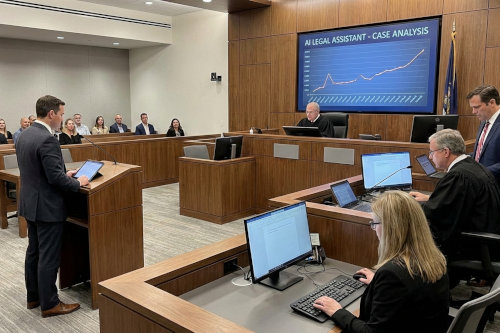
Judge David Bell: Phi Alpha Delta Legal Fraternity for Students and Professionals

Professional legal fraternity

Key Takeaways

  • Phi Alpha Delta is a professional law fraternity focused on ethical development, leadership, and service.
  • Membership includes pre-law students, law students, and legal professionals such as attorneys and judges.
  • PAD provides structured programming such as workshops, panels, mock trials, and networking events.
  • The organization emphasizes leadership development through defined officer roles and national training programs.
  • Community service is a core part of PAD’s mission and member expectations.
Continue reading

Marla Eskin: Early Eviction Resolution in Delaware Justice of the Peace Court

Eviction resolution

photo credit: Pavel Danilyuk / Pexels

Key Takeaways

  • Delaware eviction cases are handled through the Justice of the Peace Court using a structured diversion process.
  • Mediation is scheduled between filing and trial unless a statutory exception applies.
  • Participation deadlines ensure cases move forward even if one party does not engage.
  • Online Dispute Resolution and mediation conferences offer early settlement opportunities.
  • Diversion supports early resolution without delaying the court’s formal hearing process.
Continue reading

Douglas Charney: Understanding Permanent Estate And Gift Tax Rules

Calculating tax benefits

Key Takeaways

  • The One Big Beautiful Bill Act (OBBBA), enacted on July 4, 2025, permanently extends key provisions of the Tax Cuts and Jobs Act.
  • The federal estate and gift tax exemption remains high and will rise to $15 million per person starting January 1, 2026, with no sunset.
  • The generation-skipping transfer tax exemption is aligned with the estate and gift tax exemption, simplifying multigenerational planning.
  • Top marginal income tax rates and capital gains tax structures from the TCJA are now permanent.
  • The law introduces new planning considerations, including enhanced standard deductions, the repeal of the personal exemption, and the new “Trump Account.”
Continue reading

John Mickelson: Choosing the Right Executor for Your Estate

Estate planning

Key Takeaways

  • An executor plays a central fiduciary role in administering an estate and carrying out the testator’s wishes.
  • Selecting the wrong executor can lead to asset mismanagement, family disputes, and prolonged probate.
  • Executors may be family members, trusted individuals, or professional entities such as trust companies.
  • Professional executors offer neutrality, accountability, and technical expertise for complex estates.
  • Discussing the role in advance and naming an alternate executor reduces the risk of court intervention.
Continue reading

Jeff Rosenblum: Landmark OSHA Labor Cases That Defined Its Authority

OSHA labor cases

Key Takeaways

  • OSHA’s authority has been shaped through landmark Supreme Court and appellate court decisions.
  • The cotton dust case clarified that OSHA standards require feasibility analysis, not strict cost-benefit balancing.
  • Judicial interpretation reinforced OSHA’s role in setting health standards despite industry resistance.
  • The Mallard Bay case expanded OSHA jurisdiction when other federal agencies fail to actively regulate.
  • These rulings collectively established OSHA as a central enforcer of workplace safety law.
Continue reading

Niv Levy: Practical Overview Of Construction Contract Models

Construction project

Key Takeaways

  • Construction contracts define payment terms, allocate risk, and establish responsibilities to prevent disputes.
  • Cost-plus contracts offer flexibility for uncertain scopes but require oversight to control escalating costs.
  • Fixed-price contracts provide budget certainty when project details are clearly defined.
  • Unit price and time-and-materials contracts promote fairness when quantities or scope may change.
  • Design-build and guaranteed maximum price models balance efficiency, accountability, and cost control.
Continue reading

Jeff Kaliel: Pros and Cons of Joining a Class Action Lawsuit

Class Action Lawsuit

Key Takeaways

  • Class actions help individuals pursue claims that would be too costly or difficult to litigate alone.
  • Shared legal costs and contingency-fee structures make class actions financially accessible.
  • Participants benefit from consistent outcomes since all members receive the same settlement terms.
  • Drawbacks include limited control over legal decisions and potentially small individual payouts.
  • Joining a class action usually prevents future lawsuits on the same issue, making careful evaluation essential.
Continue reading

King Vanga: Why Law Firms That Ignore AI Risk Obsolescence

Law firm AI

Key Takeaways

  • AI is now a foundational part of legal workflows, not an emerging add-on.
  • Unstructured adoption creates risks, especially around accuracy and confidentiality.
  • Governance, documentation, and human verification are essential for responsible AI use.
  • Firms with structured AI oversight gain a competitive advantage with clients.
  • Legal education is evolving to prepare lawyers for hybrid human-AI practice.
Continue reading

Roger Graham of San Antonio: Practical Guidance on Estate Planning Basics

Estate planning

Key Takeaways

  • Estate planning helps protect family assets and ensures your wishes are legally documented.
  • Essential documents include a will, power of attorney, and healthcare directives.
  • Trusts can provide flexibility, privacy, and potential tax advantages for beneficiaries.
  • Recording debts and assets prevents disputes among heirs and simplifies estate distribution.
  • Gifting and charitable donations can reduce estate taxes and support long-term legacy goals.
Continue reading

Adithan Arunachalam: Utilitarianism’s Role in Public Policy and Governance

Utilitarianism in policy making

Key Takeaways

  • Utilitarianism emphasizes achieving the greatest good for the greatest number in policymaking.
  • It influences decisions in areas such as health, economics, climate policy, and criminal justice.
  • While effective in maximizing welfare, it can overlook minority rights and ethical complexities.
  • Policymakers use utilitarian reasoning to justify trade-offs and balance individual and collective needs.
  • Measuring happiness and well-being remains a major challenge in applying utilitarian principles.
Continue reading